Header image source: About Finance Bill – UPSC Current Affairs – IAS GYAN via IAS Gyan via Google — cropped to 16:9 and colour-adjusted.
Key takeaways
- A Finance Bill converts budget tax proposals into enforceable law
- Money Bills bypass Rajya Sabha amendment powers
- Finance Bills enable retrospective tax changes and GST amendments
A Finance Bill is what turns a budget speech into tax law. When the finance minister announces a new income-tax slab or a hike in customs duty, those proposals stay just that—proposals—until they’re written into a Finance Bill, debated in Parliament, and signed into law. Without it, the government can’t collect a single rupee in new taxes. It’s the difference between a fiscal wish-list and fiscal reality.
Its definition is precise: a legislative instrument that grants certain duties, alters other duties, and amends the law relating to the National Debt and the Public Revenue. Every year, the Finance Bill consolidates every tax change the government wants—GST tweaks, new levies on digital transactions, whatever—and packages them into one sprawling document. Once Parliament approves it and the President assents, it becomes the Finance Act, and its provisions snap into force. That’s the point: to convert budget resolutions into binding statute.
How a Finance Bill Is Born
The Finance Bill doesn’t appear out of nowhere. It’s the legislative endpoint of a process that starts with the budget speech. After the finance minister delivers the budget, Parliament debates its proposals and passes budget resolutions—formal decisions approving tax changes in principle. Those resolutions aren’t law. They’re political statements. The Finance Bill gives them legal teeth.
In India, the Constitution says Finance Bills can only be introduced in the Lok Sabha. This isn’t just procedure. It reflects the principle that the people’s directly elected representatives should have the final say on taxation. The Rajya Sabha plays a secondary role. If the Finance Bill is a Money Bill under Article 110, the Rajya Sabha can’t amend it at all—only make non-binding recommendations. If it’s a regular Finance Bill, the Rajya Sabha can propose amendments or even reject it, but the Lok Sabha can override those objections.
Its clauses mirror the tax proposals announced in the budget, but with the legal precision needed for enforcement. If the budget proposes a new tax on digital advertising, the Finance Bill defines "digital advertising," sets the rate, specifies the due date, and lays out penalties. This is where the rubber meets the road. The budget tells you what the government wants. The Finance Bill tells you how it will make it happen.
Money Bills vs. Other Finance Bills: The Constitutional Fine Print
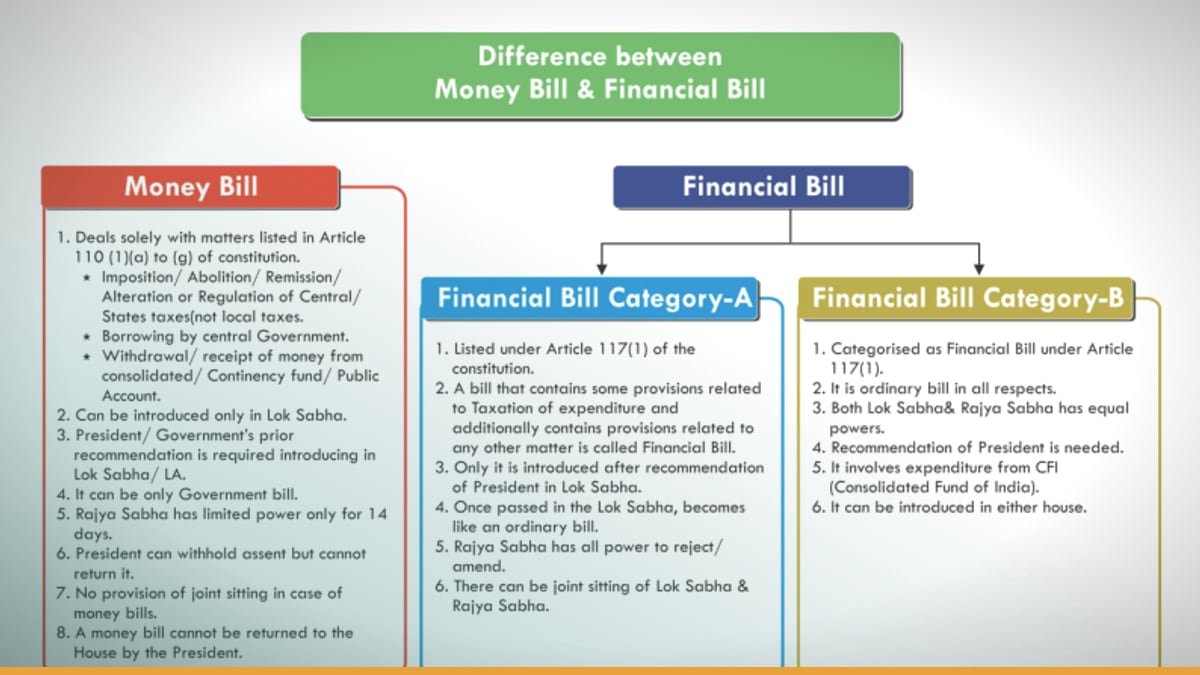
Not all Finance Bills are equal. The Constitution draws sharp lines between three categories: Money Bills (Article 110), Finance Bills under Article 117(1), and Finance Bills under Article 117(3). These distinctions decide which house of Parliament has real power—and which is sidelined.
A Money Bill is the most restrictive. It can only be introduced in the Lok Sabha, and the Rajya Sabha can’t amend it. The Speaker certifies whether a bill qualifies as a Money Bill, a power that’s sparked fierce debate. The Supreme Court has upheld the Speaker’s certification but acknowledged that the Money Bill route could be misused to bypass the Rajya Sabha.
Finance Bills under Article 117(1) are broader. They include provisions that would qualify as Money Bills under Article 110 and other general legislative matters. This gives the government flexibility to bundle tax changes with unrelated policy tweaks. The Rajya Sabha can propose amendments, but the Lok Sabha can reject them.
Finance Bills under Article 117(3) deal exclusively with expenditures from the Consolidated Fund of India—how public money is spent, not how it’s raised. These are less common in annual budgets, which focus on revenue.
There, the House of Lords has no power to amend Finance Bills. This has led to controversies when governments “tack on” non-financial measures to avoid upper-house scrutiny. Peers have complained, but the constitutional rule is clear: the Commons holds fiscal supremacy.
Parliamentary Procedure: How Finance Bills Skip the Usual Hurdles
Finance Bills don’t follow the same path as ordinary bills. Their procedure prioritizes speed and executive control—sometimes at the expense of scrutiny.
In the UK, the Public Bill Committee for a Finance Bill is roughly double the size of those for regular bills, often up to 40 members.
The Rajya Sabha’s role is constrained. For Money Bills, it has no power to amend or reject. For other Finance Bills, it can propose changes, but the Lok Sabha can override them with a simple majority.
Once both houses approve the bill (or the Lok Sabha overrides the Rajya Sabha), it goes to the President for assent. After assent, the Finance Bill becomes the Finance Act, and its provisions take effect—often retrospectively.
The Finance Act: From Paper to Law
The moment the President signs the Finance Bill, it becomes the Finance Act. This isn’t just a name change. It’s when budget proposals become binding law. Taxpayers must comply, the tax department can enforce, and courts can interpret.
Political and Constitutional Tensions: More Than Just Tax Law
Finance Bills aren’t just technical documents. They’re flashpoints for constitutional battles, executive overreach, and bicameral friction.
In the Rajya Sabha, the opposition can delay or amend non-Money Bills, but the Lok Sabha can override those changes.
Global Comparisons: How Other Democracies Handle Finance Bills
In the United Kingdom, the House of Commons holds exclusive authority over Finance Bills. This reflects the principle that taxation requires representation, as the Commons is elected. But the Lords has criticized governments for “tacking” non-financial measures onto Finance Bills.
This contrasts sharply with India’s Money Bill provisions, where the Rajya Sabha’s role is severely limited.
In Australia, the Senate has equal power with the House over money bills, except for those appropriating funds for ordinary annual government services.
Criticisms and Controversies: The Dark Side of Finance Bills
Finance Bills aren’t without critics. Three major controversies stand out: executive overreach, lack of transparency, and retrospective taxation.
Executive Overreach
Lack of Transparency
Retrospective Taxation
Judicial Deference
The Future of Finance Bills: Digital Taxation, AI, and Climate Policy
Digital Taxation The rise of the digital economy has forced governments to rethink tax frameworks.
AI and Tax Compliance
Climate Finance
Legislative Reform
Can Finance Bills Remain Both Powerful and Accountable?
Sources
- Finance Bill – MPs’ Guide to Procedure – UK Parliament
- What is the Finance Bill?
- Finance Bill or Finance Act
- Scope of Finance Bills – Erskine May – UK Parliament
- Finance Bill, Article, Meaning, Need, Types, Significance & …
- What is the difference between Money Bill and Finance Bill?
- Union Budget 2026 | FAQs: What is a Finance Bill?
Leave a Reply