Tag: indian constitution

  • **Is the Finance Commission a Statutory Body? The Constitutional Evidence**

    **Is the Finance Commission a Statutory Body? The Constitutional Evidence**

    Header image source: What is Finance Commission & what role does it perform? – The Times of India via The Times of India via Google — cropped to 16:9 and colour-adjusted.

    Key takeaways

    • Article 280 of the Indian Constitution creates the Finance Commission directly, with no enabling Act required.
    • The Finance Commission is a constitutional body, not statutory, giving it permanence and authority.
    • The 16th Finance Commission was constituted in 2023 without new legislation, proving its constitutional basis.

    Article 280 of the Indian Constitution doesn’t just mention the Finance Commission. It creates it. Full stop. No enabling Act required. No parliamentary resolution. The Constitution established the Finance Commission, with the President empowered to appoint its members. That’s not how statutory bodies work. That’s how constitutional bodies work.

    This isn’t a semantic quibble. It’s a distinction with teeth. Call the Finance Commission a statutory body, and you’ve already misunderstood its authority, its permanence, and its role in India’s federal structure. Worse, you’ve bought into a misconception that refuses to die—one peddled in UPSC guides, news reports, and even government documents.


    The 1951 Act Didn’t Create the Finance Commission—It Just Told It How to Work

    The Finance Commission (Miscellaneous Provisions) Act, 1951 is the usual suspect when confusion arises. But read the preamble:


    Article 280: The Only Foundation That Matters

    Here’s what it actually says:

    **

    (3) It shall be the duty of the Commission to make recommendations to the President as to—

    – (a) the distribution between the Union and the States of the net proceeds of taxes…

    – (b) the principles which should govern the grants-in-aid of the revenues of the States…

    – (c) any other matter referred to the Commission by the President in the interests of sound finance.


    Constitutional vs. Statutory Bodies: The Practical Differences

    Permanence and Legal Status

    • Finance Commission: Exists as long as Article 280 stands.

    Appointment and Tenure

    Quasi-Judicial Authority

    Scope of Mandate


    The First Finance Commission and the Persistent Myth of the 1951 Act

    The First Finance Commission was constituted in 1951—the same year the Finance Commission (Miscellaneous Provisions) Act was passed.

    It set out:

    If the Finance Commission were statutory:

    • Parliament could amend its mandate via ordinary legislation.

    But it’s not statutory. The President must constitute a new Commission every five years.


    Why This Distinction Matters: Real-World Consequences

    Legal Immunity and Independence

    Scope of Power

    Judicial Review

    Permanence in Governance


    Common Misconceptions—and Why They Won’t Die

    The source of authority matters more than who signs the appointment letter.

    "The Finance Commission is temporary because it’s reconstituted every five years. "

    Article 280 mandates periodic reconstitution, but the Commission as an institution is enshrined in the Constitution. Supreme Court judges have fixed tenures too, but the Court itself is permanent.


    The 16th Finance Commission: A Case Study in Constitutional Mandate

    The 16th Finance Commission was constituted on 31 December 2023, with Arvind Panagariya as Chairman. Here’s why this proves the Finance Commission is constitutional, not statutory.

    No New Legislation Was Passed

    The 16th Finance Commission was constituted without any new Act or amendment. The 1951 Act remains unchanged. If the Finance Commission were statutory, Parliament would have needed to pass a law to reconstitute it.

    Members Were Appointed by the President, Not Parliament

    The President appointed the Chairman and members under Article 280. No parliamentary approval required. Statutory bodies often require parliamentary confirmation for key appointments. SEBI’s Chairperson is appointed by the government but must meet criteria set by the SEBI Act.

    Its Recommendations Will Shape Fiscal Federalism—Without Parliamentary Approval

    The 16th Finance Commission’s report (due by October 2025) will recommend:

    • How tax revenues should be divided between the Centre and states.
    • The principles for grants-in-aid to states.

    These recommendations aren’t subject to parliamentary approval. The government can choose not to implement them, but doing so would violate the Constitution’s spirit of fiscal federalism. Statutory bodies’ reports can be rejected or modified. TRAI’s tariff orders can be challenged. The Finance Commission’s recommendations carry constitutional weight.

    The Constitution Alone Was Sufficient for Its Formation

    The only legal basis for the 16th Finance Commission is Article 280. No enabling Act was required. If it were statutory, Parliament would have had to pass a law to reconstitute it.


    The Open Question: What Happens If the Government Ignores the Finance Commission?

    The Finance Commission’s recommendations aren’t legally binding. The government can ignore them. But what happens then?

    Not much. The Constitution doesn’t require the government to implement the Finance Commission’s recommendations. That’s another story.

    Ignoring the Finance Commission would be a direct challenge to fiscal federalism. States would cry foul. The opposition would have a field day. The Supreme Court might even weigh in—though it’s unclear how. The Finance Commission’s constitutional status gives its recommendations moral and political weight, even if not legal force.

    But here’s the real question: If the government can ignore the Finance Commission without consequence, does its constitutional status even matter? The answer isn’t clear. And that’s the most unsettling implication of all.


  • **Is the Finance Commission a Quasi-Judicial Body? The Constitutional and Functional Evidence**

    Key takeaways

    • Article 280 designates Finance Commission as quasi-judicial but recommendations are advisory
    • Procedures mirror courts: fact-finding, legal interpretation, reasoned conclusions
    • Political overrides and GST Council decisions weaken quasi-judicial authority

    Article 280 says the Finance Commission is quasi-judicial. Legal scholars nod in agreement. The Commission’s own procedures—fact-finding, legal interpretation, reasoned conclusions—mirror a court’s work. But here’s the rub: its recommendations carry no binding force. The Centre can, and frequently does, ignore them when political winds shift. So is "quasi-judicial" just a constitutional label, or does it actually shape how the Commission functions? That tension demands closer scrutiny.


    Article 280 and the Quasi-Judicial Framework

    It provides for a Finance Commission to be constituted by the President every fifth year. The provision explicitly places the Commission in the quasi-judicial category.

    What does "quasi-judicial" mean in practice? The definition is straightforward: a body that isn’t a court but still interprets law, makes factual determinations, and reaches legal conclusions. It doesn’t merely offer advice; it adjudicates fiscal matters between central and state governments.


    Powers and Procedures: How the Commission Mirrors Judicial Processes

    The Finance Commission doesn’t just resemble a quasi-judicial body—it operates like one, with procedures that would be familiar in any courtroom.

    Fact-Finding as Legal Exercise

    These are findings of fact with legal consequences—precisely what quasi-judicial bodies are designed to produce.

    Legal Interpretation, Not Just Application

    The Commission doesn’t just apply formulas; it interprets constitutional and statutory provisions.

    Procedural Safeguards and Natural Justice


    The Non-Binding Paradox: Why Quasi-Judicial Status Doesn’t Ensure Compliance

    The Finance Commission’s recommendations are advisory, not binding.

    The 14th Finance Commission’s 42% Devolution: A Case Study in Political Override

    Judicial Review: A Theoretical Safeguard

    Decisions of quasi-judicial bodies are typically subject to judicial review, and the Finance Commission’s recommendations can be challenged in court.

    The GST Council’s Encroachment


    Case Studies: When the Commission’s Authority Was Put to the Test

    1. The 14th Finance Commission (2015–20): The 42% Devolution Controversy

    2. The 15th Finance Commission (2020–25): The Census Data Dispute

    3. The 7th Finance Commission (1979): Ignored Grants for Drought-Prone States


    Legal Scholarship and the Debate Over the Quasi-Judicial Label

    Arguments for the Classification

    Criticisms of the Label

    Comparative Perspective: How Other Countries Handle Fiscal Adjudication


    The Political Economy of Quasi-Judicial Authority

    Here’s why it matters:

    Parliamentary Sovereignty vs. Quasi-Judicial Independence

    This is a deliberate check on the Commission’s authority, ensuring that democratic accountability trumps adjudicatory independence.

    Flexibility in Macroeconomic Management

    The non-binding nature of the Commission’s recommendations gives the Centre flexibility to respond to crises. For example, during the 2008 financial crisis, the Centre deviated from the 13th Finance Commission’s recommendations to provide stimulus packages to states.

    State vs. Centre Tensions

    States often accuse the Centre of cherry-picking the Commission’s recommendations. The 15th Finance Commission’s performance-based grants, for instance, were hailed by the Centre as a way to incentivize fiscal discipline but criticized by states as centralization in disguise. The Commission’s quasi-judicial status gives its recommendations moral weight, but the Centre’s discretion ensures that politics always has the final say.

    The GST Council’s Rise and the Commission’s Decline?

    The GST Council, a political body, has increasingly become the primary fiscal arbiter between the Centre and states. Its decisions on tax rates and revenue sharing often override the Finance Commission’s projections. This raises a critical question: Is the Commission’s quasi-judicial role being sidelined by a more political (and more powerful) body?


    The Finance Commission: A Quasi-Judicial Body in Form, Not in Full Force

    So, is the Finance Commission a quasi-judicial body? The answer is yes—but with a glaring caveat.

    • Constitutional text (Article 280) and legal definitions confirm its quasi-judicial status.
    • Adjudicatory functions—fact-finding, legal interpretation, reasoned conclusions—align it with quasi-judicial bodies.
    • Non-binding recommendations and political overrides mean its authority is more symbolic than enforceable.

    The Finance Commission is a hybrid: quasi-judicial in structure and procedure, but advisory in effect. It’s more like an arbitrator than a court—empowered to interpret the law but not to enforce it.

    This raises a critical question for India’s fiscal federalism: Should the Commission’s recommendations be made binding? Proponents argue that this would align its authority with its quasi-judicial status, reducing political interference. Critics warn that it could centralize fiscal power, stripping Parliament of its budgetary sovereignty.

    For now, the Finance Commission remains a constitutional paradox: a quasi-judicial body whose rulings are treated as suggestions, not mandates. Whether that’s a flaw or a feature depends on perspective. But one thing is clear: the quasi-judicial label isn’t just semantics—it shapes how the Commission operates, even if it doesn’t guarantee compliance. The real question is whether India’s evolving fiscal landscape will leave room for this hybrid model, or if the Commission’s role will continue to diminish in the shadow of more political bodies like the GST Council.


  • **Is the Finance Commission a Constitutional Body? The Legal and Functional Evidence**

    Key takeaways

    • Article 280 mandates the Finance Commission’s creation by presidential order
    • Only constitutional amendment can dissolve the Finance Commission
    • The Commission resolves Centre-state fiscal imbalances constitutionally

    Article 280 doesn’t just mention the Finance Commission. It creates it. Full stop.

    The Indian Constitution doesn’t leave room for ambiguity here. The Finance Commission isn’t some advisory committee that Parliament can dissolve with a simple majority. It’s a constitutional body, mandated every five years by presidential order, with functions explicitly defined in the text. Vajiram & Ravi, a leading UPSC coaching institute, states it plainly: The Finance Commission is a constitutional body established under Article 280 of the Indian Constitution. Model Diplomat echoes this: The Finance Commission of India is a constitutional body established under Article 280 of the Constitution of India. These aren’t opinions. They’re facts, grounded in the Constitution’s unambiguous language.


    Article 280: The Birth Certificate

    Article 280 isn’t just a reference. It’s the Finance Commission’s foundation. The text is worth quoting in full:

    The President shall, within two years from the commencement of this Constitution and thereafter at the expiration of every fifth year or at such earlier time as the President considers necessary, by order constitute a Finance Commission which shall consist of a Chairman and four other members.

    Let’s break this down.

    "The President shall. " This isn’t optional. The President must constitute the Commission. No debate. No discretion.

    "Every fifth year. " The Constitution doesn’t just suggest a timeline. It mandates one. The only flexibility is for earlier reconstitution if needed.

    "By order constitute. "By order constitute.** The Commission isn’t created by legislation. It’s established by presidential order—a direct exercise of constitutional authority.

    The 1992 amendment expanded the Finance Commission’s duties to include recommendations for Panchayats and Municipalities. But it didn’t change the body’s fundamental status. The amendment added functions, not legitimacy. The Finance Commission’s constitutional moorings remained intact.


    How the Finance Commission Stands Apart

    Not all fiscal bodies are created equal. The Finance Commission’s constitutional status sets it apart from statutory bodies like the RBI or SEBI. Those were created by acts of Parliament. They can be dissolved or amended by legislative action. The Finance Commission? It exists because the Constitution says it must.

    This distinction matters.

    Permanence. Statutory bodies can be abolished by Parliament. The Finance Commission cannot. Only a constitutional amendment could remove it.

    Authority. The Finance Commission’s recommendations aren’t legally binding. But the Constitution requires the President to constitute it and consider its advice. This is a higher-order obligation than the advisory role of non-constitutional bodies like NITI Aayog.

    Federalism. The Finance Commission is the only body explicitly tasked with resolving vertical and horizontal fiscal imbalances between the Centre and states. The GST Council handles tax rates. It doesn’t replace the Finance Commission’s devolution role.

    The Planning Commission offers a useful contrast. It existed from 1950 to 2015 as a non-constitutional, executive body created by a Cabinet resolution. Its dissolution in 2015—replaced by NITI Aayog—was a simple executive decision. The Finance Commission, on the other hand, is untouchable without a constitutional amendment.


    The President’s Role: More Than Ceremony

    The President’s role in constituting the Finance Commission isn’t ceremonial. It’s a constitutional duty. Article 280 leaves no ambiguity: the President shall appoint the Commission every five years, or earlier if necessary. This isn’t subject to legislative approval.

    But what happens if the President delays? The 15th Finance Commission was constituted later than the usual timeline. This delay sparked debates about federalism and Centre-state relations. But it didn’t undermine the Commission’s constitutional status. Even a delayed appointment doesn’t negate the body’s existence or mandate.

    The Finance Commission’s recommendations carry significant weight. The Union government typically accepts them, though deviations do occur. The 14th Finance Commission’s recommendation to increase states’ share of tax revenues was accepted. But it also faced resistance from some states. The 15th Finance Commission’s use of more recent census data for devolution formulas led to protests from some states. They argued their population control efforts were being penalized. These controversies highlight the Commission’s political centrality. But they don’t change its constitutional foundation.


    The Core Functions: A Constitutional Mandate

    The Finance Commission’s duties aren’t just important. They’re constitutionally mandated. Article 280 outlines four primary functions:

    1. Vertical devolution. Determining the distribution of net tax proceeds between the Centre and states.
    2. Horizontal devolution. Establishing principles for allocating funds among states, based on factors like population, area, and fiscal capacity.
    3. Grants-in-aid. Recommending principles for grants to states from the Consolidated Fund of India.
    4. Local bodies. Post-1992, recommending measures to augment funds for Panchayats and Municipalities.

    These functions aren’t just administrative. They’re foundational to India’s fiscal federalism. The Finance Commission is the only body explicitly tasked with resolving vertical and horizontal imbalances. The GST Council doesn’t replace this role. It handles tax rates, not revenue devolution.

    The numbers tell the story:

    • The 14th Finance Commission (2015–20) increased states’ share of taxes from 32% to 42%.
    • The 15th Finance Commission (2021–26) retained 41% devolution but introduced performance-based incentives for states.

    These aren’t just policy choices. They’re constitutional obligations.


    Misconceptions and Clarifications

    Despite its clear constitutional status, the Finance Commission is often misunderstood. Here’s why the common misconceptions are wrong.

    The Finance Commission is just an advisory body. While its recommendations aren’t binding, its creation, composition, and functions are constitutionally mandated. The Supreme Court’s advisory opinions under Article 143 are also non-binding. But no one questions the Court’s constitutional status. The Finance Commission’s role is similarly protected.

    Parliament can dissolve the Finance Commission. Parliament cannot dissolve it. Only a constitutional amendment could remove Article 280. The Planning Commission, a non-constitutional body, was dissolved by executive action in 2015. The Finance Commission cannot meet the same fate.

    State Finance Commissions are the same as the Finance Commission. State Finance Commissions (SFCs) are constitutional bodies. But they operate at the state level under Articles 243I and 243Y. They review finances of local bodies, not Centre-state relations. The Finance Commission deals with Union-State fiscal federalism. SFCs handle State-Local body finances.


    Legal and Political Implications

    The Finance Commission’s constitutional status has profound legal and political implications.

    Judicial interpretation. The Supreme Court has consistently treated the Finance Commission as a constitutional safeguard. In K.S. Puttaswamy v. The Supreme Court has referenced the Commission’s role in fiscal federalism as a constitutional mechanism, not just a policy tool. No court has ever questioned its status. The Constitution leaves no room for doubt.

    Political leverage. States lobby the Finance Commission aggressively because its recommendations carry constitutional weight. Southern states’ objections to the 15th Finance Commission’s use of 2011 Census data highlight its political centrality. Outlook India noted: The Finance Commission serves as the key constitutional mechanism for ensuring fiscal federalism in the country. This isn’t just rhetoric. It’s a recognition of the body’s institutional power.

    Federalism debates. The Finance Commission is often cited in discussions about cooperative federalism. While its neutrality is sometimes contested, its constitutional mandate ensures it remains a neutral arbiter in fiscal disputes. States may disagree with its recommendations. But they can’t ignore its existence—or its authority.


    Could the Finance Commission Ever Lose Its Status?

    No. Not without a constitutional revolution.

    Article 368 allows for amendments. But removing Article 280 would require:

    • A two-thirds majority in Parliament.
    • Ratification by half of India’s state legislatures.

    Politically, this is nearly impossible. States would fiercely resist losing a constitutional guarantee of revenue shares. The Finance Commission isn’t just a body. It’s a cornerstone of federalism. Dismantling it would require dismantling a core part of India’s constitutional architecture.

    Even if alternative mechanisms were proposed—like expanding the GST Council’s role—they wouldn’t replace the Finance Commission’s devolution function. The GST Council handles tax rates, not revenue distribution. NITI Aayog, a non-constitutional body, lacks the authority to make binding recommendations on fiscal transfers.


    The evidence is overwhelming. The Finance Commission is a constitutional body. Its creation is mandated by Article 280. Its appointment is a presidential duty. Its functions are critical to fiscal federalism. Unlike statutory bodies, it cannot be dissolved by legislative action. Unlike advisory bodies, its existence is enshrined in the Constitution’s text.

    States and the Centre must engage with its recommendations, even if they disagree. Any attempt to dilute its role would require a constitutional amendment. This makes it one of India’s most institutionally secure fiscal bodies.

    The real question isn’t whether the Finance Commission is a constitutional body. It is. The more interesting question is what happens if its recommendations are consistently ignored. Can a constitutional body remain effective if its advice is sidelined? That’s the tension at the heart of India’s fiscal federalism. And it’s a debate that’s far from over.


  • **What Is a Finance Bill?: The Legislative Engine of Fiscal Policy**

    **What Is a Finance Bill?: The Legislative Engine of Fiscal Policy**

    Header image source: About Finance Bill – UPSC Current Affairs – IAS GYAN via IAS Gyan via Google — cropped to 16:9 and colour-adjusted.

    Key takeaways

    • A Finance Bill converts budget tax proposals into enforceable law
    • Money Bills bypass Rajya Sabha amendment powers
    • Finance Bills enable retrospective tax changes and GST amendments

    A Finance Bill is what turns a budget speech into tax law. When the finance minister announces a new income-tax slab or a hike in customs duty, those proposals stay just that—proposals—until they’re written into a Finance Bill, debated in Parliament, and signed into law. Without it, the government can’t collect a single rupee in new taxes. It’s the difference between a fiscal wish-list and fiscal reality.

    Its definition is precise: a legislative instrument that grants certain duties, alters other duties, and amends the law relating to the National Debt and the Public Revenue. Every year, the Finance Bill consolidates every tax change the government wants—GST tweaks, new levies on digital transactions, whatever—and packages them into one sprawling document. Once Parliament approves it and the President assents, it becomes the Finance Act, and its provisions snap into force. That’s the point: to convert budget resolutions into binding statute.


    How a Finance Bill Is Born

    The Finance Bill doesn’t appear out of nowhere. It’s the legislative endpoint of a process that starts with the budget speech. After the finance minister delivers the budget, Parliament debates its proposals and passes budget resolutions—formal decisions approving tax changes in principle. Those resolutions aren’t law. They’re political statements. The Finance Bill gives them legal teeth.

    In India, the Constitution says Finance Bills can only be introduced in the Lok Sabha. This isn’t just procedure. It reflects the principle that the people’s directly elected representatives should have the final say on taxation. The Rajya Sabha plays a secondary role. If the Finance Bill is a Money Bill under Article 110, the Rajya Sabha can’t amend it at all—only make non-binding recommendations. If it’s a regular Finance Bill, the Rajya Sabha can propose amendments or even reject it, but the Lok Sabha can override those objections.

    Its clauses mirror the tax proposals announced in the budget, but with the legal precision needed for enforcement. If the budget proposes a new tax on digital advertising, the Finance Bill defines "digital advertising," sets the rate, specifies the due date, and lays out penalties. This is where the rubber meets the road. The budget tells you what the government wants. The Finance Bill tells you how it will make it happen.


    Money Bills vs. Other Finance Bills: The Constitutional Fine Print

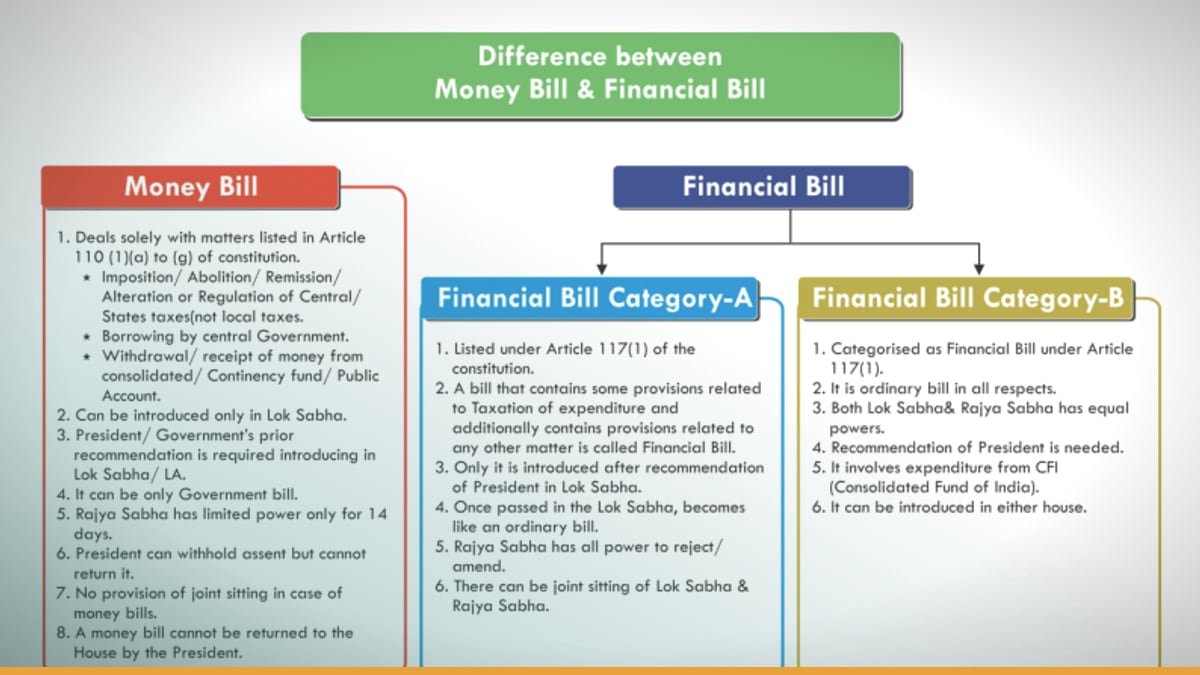
    Not all Finance Bills are equal. The Constitution draws sharp lines between three categories: Money Bills (Article 110), Finance Bills under Article 117(1), and Finance Bills under Article 117(3). These distinctions decide which house of Parliament has real power—and which is sidelined.

    A Money Bill is the most restrictive. It can only be introduced in the Lok Sabha, and the Rajya Sabha can’t amend it. The Speaker certifies whether a bill qualifies as a Money Bill, a power that’s sparked fierce debate. The Supreme Court has upheld the Speaker’s certification but acknowledged that the Money Bill route could be misused to bypass the Rajya Sabha.

    Finance Bills under Article 117(1) are broader. They include provisions that would qualify as Money Bills under Article 110 and other general legislative matters. This gives the government flexibility to bundle tax changes with unrelated policy tweaks. The Rajya Sabha can propose amendments, but the Lok Sabha can reject them.

    Finance Bills under Article 117(3) deal exclusively with expenditures from the Consolidated Fund of India—how public money is spent, not how it’s raised. These are less common in annual budgets, which focus on revenue.

    There, the House of Lords has no power to amend Finance Bills. This has led to controversies when governments “tack on” non-financial measures to avoid upper-house scrutiny. Peers have complained, but the constitutional rule is clear: the Commons holds fiscal supremacy.


    Parliamentary Procedure: How Finance Bills Skip the Usual Hurdles

    Finance Bills don’t follow the same path as ordinary bills. Their procedure prioritizes speed and executive control—sometimes at the expense of scrutiny.

    In the UK, the Public Bill Committee for a Finance Bill is roughly double the size of those for regular bills, often up to 40 members.

    The Rajya Sabha’s role is constrained. For Money Bills, it has no power to amend or reject. For other Finance Bills, it can propose changes, but the Lok Sabha can override them with a simple majority.

    Once both houses approve the bill (or the Lok Sabha overrides the Rajya Sabha), it goes to the President for assent. After assent, the Finance Bill becomes the Finance Act, and its provisions take effect—often retrospectively.


    The Finance Act: From Paper to Law

    The moment the President signs the Finance Bill, it becomes the Finance Act. This isn’t just a name change. It’s when budget proposals become binding law. Taxpayers must comply, the tax department can enforce, and courts can interpret.


    Political and Constitutional Tensions: More Than Just Tax Law

    Finance Bills aren’t just technical documents. They’re flashpoints for constitutional battles, executive overreach, and bicameral friction.

    In the Rajya Sabha, the opposition can delay or amend non-Money Bills, but the Lok Sabha can override those changes.


    Global Comparisons: How Other Democracies Handle Finance Bills

    In the United Kingdom, the House of Commons holds exclusive authority over Finance Bills. This reflects the principle that taxation requires representation, as the Commons is elected. But the Lords has criticized governments for “tacking” non-financial measures onto Finance Bills.

    This contrasts sharply with India’s Money Bill provisions, where the Rajya Sabha’s role is severely limited.

    In Australia, the Senate has equal power with the House over money bills, except for those appropriating funds for ordinary annual government services.


    Criticisms and Controversies: The Dark Side of Finance Bills

    Finance Bills aren’t without critics. Three major controversies stand out: executive overreach, lack of transparency, and retrospective taxation.

    Executive Overreach

    Lack of Transparency

    Retrospective Taxation

    Judicial Deference


    The Future of Finance Bills: Digital Taxation, AI, and Climate Policy

    Digital Taxation The rise of the digital economy has forced governments to rethink tax frameworks.

    AI and Tax Compliance

    Climate Finance

    Legislative Reform


    Can Finance Bills Remain Both Powerful and Accountable?