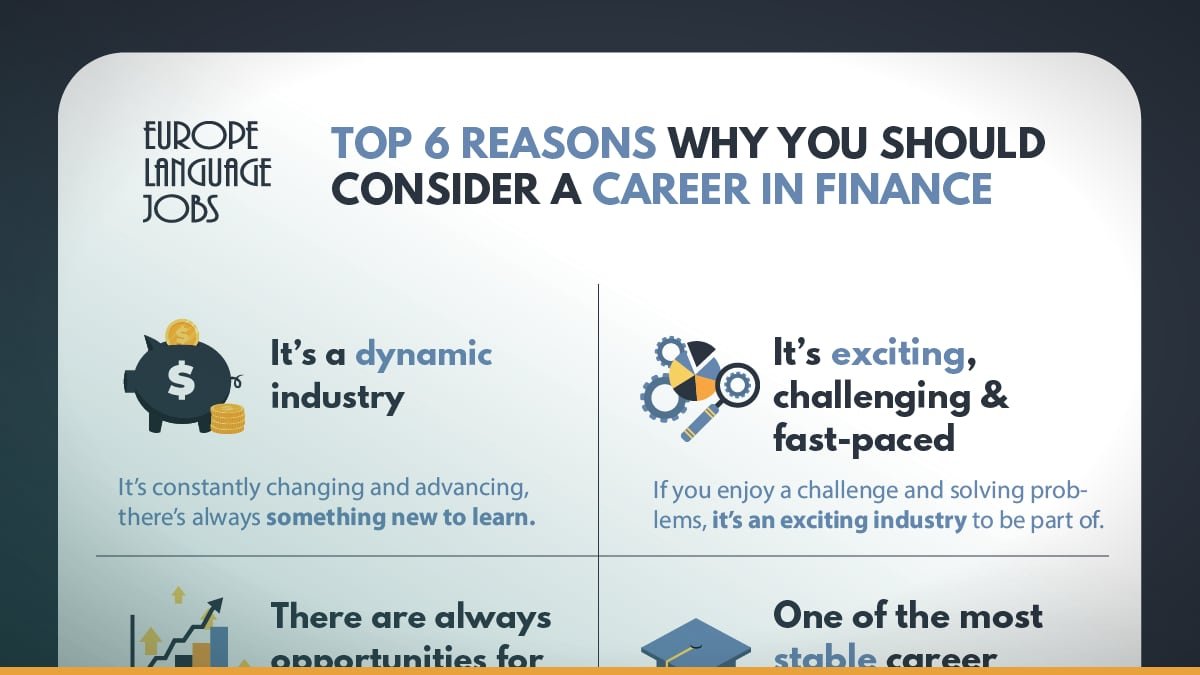
Header image source: Why You Should Choose a Career in Finance: Top 6 Reasons via Europe Language Jobs via Google — cropped to 16:9 and colour-adjusted.
Key takeaways
- Finance still offers top-tier salaries and fast career progression, especially in investment banking and private equity
- AI and automation are eliminating routine finance jobs while creating new roles in fintech, blockchain and AI-driven investing
- Success in finance requires analytical skills, tolerance for long hours, and adaptability to new technologies
Finance pays. That’s the first thing anyone thinking about the industry needs to understand. High pay for investment banking analysts straight out of undergrad. High pay for private equity associates a few years later. Strong salary potential for personal finance advisors, with top performers earning significantly more. The Bureau of Labor Statistics projects nearly 30% growth in that last category over the next decade. Money talks, and in finance, it screams.
But the golden era of finance—roughly 1980 to 2020—is over. Back then, finance careers were highly desirable. Top MBA programs sent many of their graduates into finance, and the field became highly desirable. Now? Tech and AI are muscling in on the same talent. Tech careers now offer strong compensation that competes with finance. AI careers now offer exceptional compensation that competes with finance. Regulatory changes and market evolution have impacted traditional finance models. Finance is still strong. But it’s no longer the only game in town.
The Financial Rewards: Why Money Still Talks
Finance pays. And it pays fast. Here’s how the numbers break down:
- Entry-level: Investment banking analysts start with high compensation. Private equity associates jump straight to high compensation.
- Mid-career: Vice Presidents in banking earn strong compensation. Hedge fund portfolio managers can earn exceptional compensation.
- Senior roles: Managing Directors in investment banking earn top-tier compensation. Fortune 500 CFOs earn top-tier compensation.
The career ladder is steep but clear. From analyst to VP in banking offers fast career progression. From associate to partner in private equity offers fast career progression. Compare that to tech, where career growth often stalls after senior engineer, or consulting, where promotions slow after manager. Finance rewards ambition with speed—but only if you’re willing to pay the price.
The price? Hours. Investment banking analysts routinely work extremely long hours. Private equity associates aren’t far behind. Burnout is real. Many junior bankers consider leaving within a few years due to burnout. The culture in finance means job security can be fragile, especially in downturns. If you want money without the stress, finance isn’t the answer.
The Intellectual Appeal: Why Smart People Still Choose Finance
Finance attracts the analytically minded because it offers rigor, global exposure, and problem-solving under pressure. Finance careers reward decision-making skills, quantitative analysis, and market intuition. Whether you’re modeling a leveraged buyout, trading currencies, or structuring a green bond, the work is demanding.
The skills are also highly transferable. Mastering Excel, financial modeling, and valuation techniques opens doors beyond finance—into tech, consulting, or entrepreneurship. Many ex-bankers launch startups, join growth-stage companies, or pivot into venture capital. Finance graduates develop stakeholder management, negotiation, and risk assessment skills that are valuable in any industry.
But let’s be honest. Not all finance jobs are intellectually stimulating. Pitch books, compliance reports, and quarterly earnings models can feel repetitive. If you crave creativity or hands-on innovation, fields like AI research or product development might be more fulfilling.
The New Frontiers: Fintech, Blockchain, and AI Are Reshaping Finance
Traditional finance roles—banking, accounting, asset management—are no longer the only paths. Careers in fintech, blockchain, and AI-driven investing are growing. Here’s where the growth is:
- Fintech: Digital payments, neobanks, and regulatory technology.
- Blockchain & Crypto: Decentralized finance, smart contracts, and tokenization of assets.
- Green Finance: ESG investing, carbon trading, and sustainable lending.
- AI-Driven Investing: Quantitative funds, robo-advisors, and predictive analytics.
These fields demand hybrid skills: finance plus coding, finance plus data science, or finance plus regulatory expertise. If you’re a traditional banker who can’t code, you’re at risk of being automated out of a job. Routine financial analysis—earnings reports, basic valuation—is increasingly handled by AI. The future belongs to those who can leverage technology, not just crunch numbers.
The Dark Side: Stress, Burnout, and Why Finance Isn’t for Everyone
Finance is not a "safe" career. The hours are brutal. The stress is constant. Job security is fragile. Here’s what you’re signing up for:
- Extreme hours: Extremely long work weeks in investment banking, private equity, and hedge funds.
- High stress: Market crashes, deal deadlines, and performance-based compensation create relentless pressure.
- Job insecurity: Layoffs are common in downturns. The culture in finance means failure to advance can mean forced exits.
- Work-life imbalance: Missed weddings, canceled vacations, and strained relationships are common sacrifices.
Who struggles in finance? People who:
- Hate repetitive work—financial modeling, pitch books, compliance.
- Prioritize work-life balance—tech offers better hours at similar pay.
- Lack analytical or sales skills—client-facing roles require extroversion.
- Are risk-averse—prefer stability over high rewards.
If you need creativity, flexibility, or stability, finance is a terrible fit. But if you thrive under pressure, love numbers, and want financial success above all else, it can be incredibly rewarding.
Finance vs. Other Elite Careers: How It Stacks Up in 2024
| Factor | Finance | Tech (FAANG/AI) | Consulting | Entrepreneurship | |———————–|————|———————|—————-|———————-| | Earning Potential | ★★★★★ (top 1%) | ★★★★☆ (high but variable) | ★★★☆☆ | ★★★★★ (if successful) | | Career Speed | ★★★★★ (fast promotions) | ★★★☆☆ (flatter hierarchies) | ★★★★☆ | ★☆☆☆☆ (slow, risky) | | Work-Life Balance | ★☆☆☆☆ | ★★★☆☆ | ★★☆☆☆ | ★★★★☆ (if successful) | | Intellectual Challenge | ★★★★☆ (analytical) | ★★★★★ (innovative) | ★★★☆☆ (problem-solving) | ★★★★★ (creative) | | Exit Opportunities | ★★★★★ (PE, hedge funds, startups) | ★★★★☆ (other tech firms, finance) | ★★★★☆ (corporate, finance) | ★★☆☆☆ (limited) | | Prestige | ★★★★★ (Wall Street, PE) | ★★★★☆ (Silicon Valley) | ★★★★☆ (McKinsey, BCG) | ★★★☆☆ (varies) |
Where finance wins: Earnings, career speed, prestige, exit opportunities.
Where finance loses: Work-life balance, creativity, stability.
Finance is still the best career for pure earning power and career acceleration. But tech and entrepreneurship are closing the gap. If you want innovation and flexibility, other fields may now offer better alternatives.
Who Should (and Shouldn’t) Pursue Finance?
Finance is a great career if you:
- Want to make a lot of money quickly—and are willing to work for it.
- Enjoy analytical, high-pressure work—modeling, trading, deal execution.
- Value prestige, global exposure, and structured career growth.
- Can handle stress, long hours, and job insecurity.
- Are interested in fintech, blockchain, or AI-driven finance.
Finance is a bad career if you:
- Prioritize work-life balance—9–5, remote work.
- Hate repetitive tasks—Excel, pitch books, compliance.
- Want creative or hands-on work—coding, product design, research.
- Lack analytical or sales skills—struggle with numbers or client management.
- Are risk-averse—prefer stability over high rewards.
The Future of Finance Careers: What’s Next?
Finance is evolving. Fast. Here’s what’s coming:
- AI and automation will eliminate routine jobs—trading desks, basic financial analysis—but create new roles like AI model validation and algorithmic risk management.
- Fintech and blockchain will dominate entry-level hiring, replacing traditional banking roles.
- ESG and green finance will grow as regulations and investor demand increase.
- Remote work will become more common in fintech startups and quant funds but remain rare in traditional finance like investment banking and private equity.
How to future-proof a finance career:
- Learn coding—Python, SQL, R—to compete with AI.
- Specialize in high-growth areas—fintech, crypto, ESG, AI investing.
- Develop hybrid skills—finance plus data science, finance plus product management.
- Build a personal brand—LinkedIn, Substack, fintech side projects.
The next generation of finance leaders won’t just be bankers or traders. They’ll be fintech founders, crypto investors, and AI-driven portfolio managers. If you don’t adapt, you’ll get left behind.
The question isn’t just Is finance a good career? It’s Is finance the right career for you? The answer depends on what you value most. If it’s money, challenge, and prestige, finance delivers. If it’s balance, creativity, or stability, look elsewhere. The golden age of finance may be over, but the next era is just beginning—and it’s more exciting than ever.
Sources
- Is Finance a Good Career Path? Predictions for 2040
- Is Finance A Good Career Path?
- What Makes Finance a Good Career Path?
- Is Finance the Right Career for You? (Ask Yourself these …
- 7 Reasons Why You Should Consider a Career In Finance
- Why I love my career: The pros of a job in finance
- Fintech to crypto: 5 new age finance careers you should know in 2025