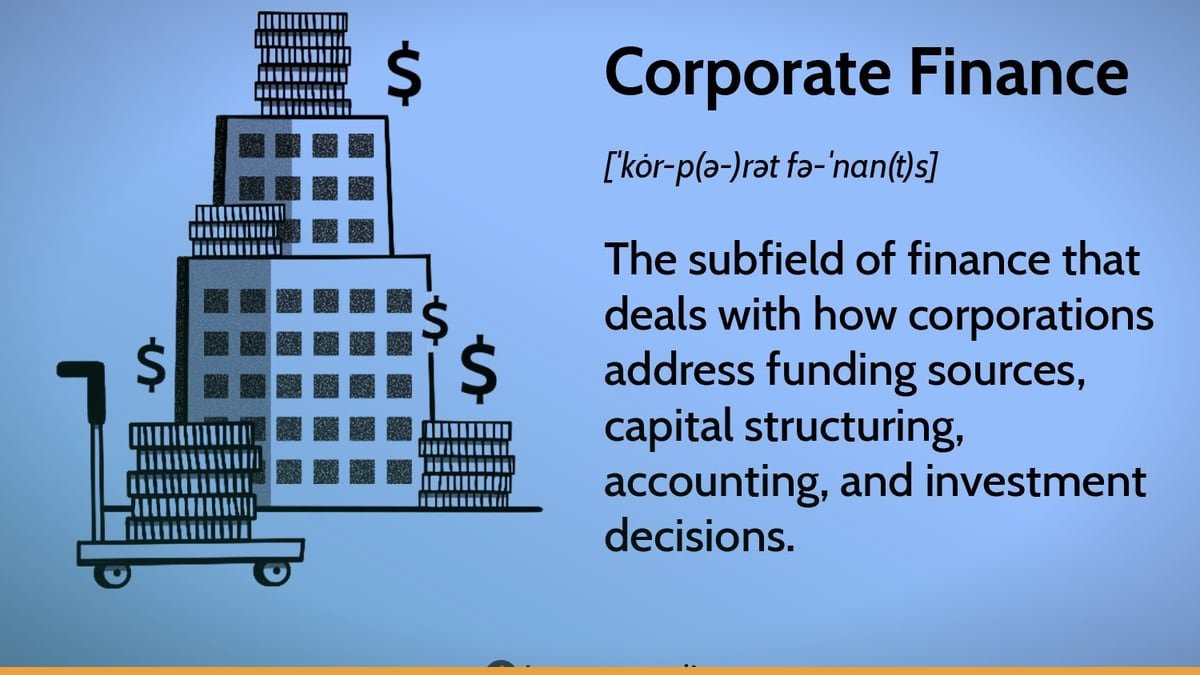
Header image source: Corporate Finance: Definition and Activities via Investopedia via Google — cropped to 16:9 and colour-adjusted.
Key takeaways
- Finance is the system that moves, measures, and multiplies money across personal, corporate, and public branches
- Core finance tools include time value of money, risk assessment, and financial statements
- Finance evolved from medieval debt settlement to today’s digital markets and quantitative models
Finance isn’t about money sitting still. It’s about money in motion—invested, borrowed, lent, budgeted, saved, forecasted—with every action measured, valued, and designed to shape what comes next. The Corporate Finance Institute defines finance as a set of activities. That’s the key. Finance happens when a bank finances a loan or an investor allocates capital. Merriam-Webster’s definition—"money or other liquid resources"—misses the point entirely. Money is just the raw material. Finance is the system that moves it, measures it, multiplies it.
That system splits into three branches—personal, corporate, public—each using the same tools but at different scales. The question is always the same: How do we use money today to achieve goals tomorrow?
The Three Branches of Finance: Who Uses It and Why
Personal Finance: Money Management for Individuals
Personal finance is the branch everyone touches, whether they realise it or not. It’s about saving for emergencies, investing for retirement, borrowing for a home, budgeting to avoid debt. Investopedia frames it as managing money for long-term security (retirement, education funds) and short-term needs (paying bills, building an emergency fund). The tools are familiar—mortgages, credit cards, savings accounts, 401(k)s—but the principles are universal: time value of money, risk tolerance, opportunity cost.
Take a student loan versus the stock market. The math is clear, but the decision hinges on trade-offs. Finance gives you the framework to quantify them. Should you take a 3% mortgage or a 5% personal loan? The numbers don’t lie, but the choice depends on your goals, timeline, and appetite for risk.
Corporate Finance: How Businesses Fund Growth
Corporate finance is where things get abstract but no less critical. It’s about how businesses raise capital, deploy it, and return value to shareholders. The Corporate Finance Institute frames it as maximising shareholder value while balancing risk, liquidity, and growth. This means issuing stocks, taking on debt (bonds, loans), managing cash flow, and making investment decisions—like building a new factory or acquiring a competitor.
A key concept here is capital structure—the mix of debt and equity a company uses to fund operations. Too much debt, and the company risks bankruptcy. Too little, and it might miss growth opportunities. Then there’s working capital management, ensuring liquidity to cover day-to-day operations. Tesla burned through cash for years before turning a profit—corporate finance dictated how much debt it could take on and how long investors would tolerate losses.
Public Finance: How Governments Spend (and Tax)
Public finance is the least visible but most consequential branch for most people. It’s how governments collect revenue (taxes, tariffs) and allocate it (infrastructure, welfare, defence). Investopedia describes it as the study of government spending and debt issuance, including fiscal policy (taxation, spending) and monetary policy (interest rates, money supply). The goal? Stabilise the economy, fund public goods, redistribute wealth—or fail to, depending on political priorities.
The U.S. federal budget in 2023 allocated $1.7 trillion to mandatory spending (Social Security, Medicare) and $1.4 trillion to discretionary spending (defence, education). Public finance determines how those numbers are calculated, justified, and adjusted. Should the government issue bonds to fund a new highway? Should it raise taxes to reduce the deficit? These aren’t just political questions—they’re financial calculations with real-world consequences.
The Overlap: Same Tools, Different Scales
All three branches rely on the same core activities:
- Borrowing (mortgages, corporate bonds, government debt).
- Investing (stocks, real estate, infrastructure projects).
- Forecasting (retirement planning, earnings projections, GDP growth).
The difference is scale and stakes. A miscalculation in personal finance might mean delaying retirement. In corporate finance, it could bankrupt a company. In public finance, it could trigger a recession.
Finance as a Measurement System: Turning Intuition Into Numbers
Finance doesn’t invent new truths—it quantifies what we already sense intuitively. OpenStax puts it well: finance "attempts to measure with numbers what we already ‘know’ about financial situations. " A business owner knows a project is profitable, but finance proves it with ROI calculations, payback periods, and net present value (NPV). A homebuyer feels a mortgage is affordable, but finance confirms it with debt-to-income ratios and amortisation schedules.
The Tools of Measurement
- Time Value of Money (TVM): The foundation of finance. A dollar today is worth more than a dollar tomorrow because it can be invested to earn returns. TVM explains why banks charge interest—they’re compensating for the time value of their money—and why investors discount future cash flows.
- Risk Assessment: Finance quantifies uncertainty. Credit scores (FICO), volatility metrics (beta), and Value at Risk (VaR) models turn "gut feelings" about risk into actionable data. A bond rated BBB+ is less risky than one rated CCC, but finance tells you how much less risky—and what that means for your portfolio.
- Financial Statements: The scorecards of finance. A balance sheet shows what a company owns (assets) and owes (liabilities). An income statement tracks revenue and expenses. A cash flow statement reveals how money moves in and out. Together, they turn business decisions into trackable, comparable data.
Why Measurement Matters
Without measurement, finance would be guesswork. Numbers make it predictable, comparable, improvable. Consider two investments:
- Investment A: 10% return, 15% volatility.
- Investment B: 8% return, 5% volatility.
Which is better? It depends on your risk tolerance—but finance gives you the language to discuss the trade-off. Without those numbers, you’re just guessing.
The Core Activities of Finance: What It Actually Does
Finance isn’t a monolith—it’s a collection of actions that move money through the economy. Here’s what those actions look like in practice:
Investing: Allocating Capital for Future Returns
Investing is about putting money into assets (stocks, bonds, real estate, startups) with the expectation of future returns. The driving principle is the risk-return tradeoff: higher potential rewards usually mean higher risk. Investopedia frames it as the balance between growth and safety—stocks offer growth but volatility; bonds offer safety but lower returns.
Key concepts:
- Diversification: Spreading investments across assets to reduce risk (e.g., holding stocks, bonds, and cash).
- Asset allocation: Dividing a portfolio between different asset classes (e.g., 60% stocks, 30% bonds, 10% cash).
- Liquidity: How easily an asset can be converted to cash (a savings account is liquid; a rental property is not).
Warren Buffett’s investment strategy—buying undervalued companies and holding them long-term—is a financial decision rooted in measurement (price-to-earnings ratios, cash flow analysis) and patience.
Borrowing and Lending: The Engine of Economic Growth
Borrowing and lending move money from those who have it (savers, investors) to those who need it (borrowers, businesses, governments). The cost of this money is interest, which reflects:
- Time value of money (compensation for waiting).
- Risk (higher risk = higher interest rates).
- Inflation (lenders demand returns that outpace rising prices).
OpenStax highlights how this works in practice: a bank finances a mortgage by lending money to a homebuyer, who repays it with interest over 30 years. The bank’s profit comes from the spread—the difference between the interest it pays depositors and the interest it charges borrowers.
Budgeting: Aligning Spending with Goals
Budgeting is the planning of income and expenses to avoid deficits and achieve goals. It’s used by:
- Individuals (tracking monthly spending, saving for a vacation).
- Businesses (forecasting revenue, controlling costs).
- Governments (balancing tax revenue with spending priorities).
The Corporate Finance Institute calls budgeting the cornerstone of financial planning—without it, spending spirals out of control. A company that budgets poorly might run out of cash. A government that does so might face a debt crisis.
Forecasting: Predicting the Future (With Caveats)
Forecasting uses historical data, statistical models, and assumptions to predict future financial conditions. It’s critical for:
- Businesses (projecting sales, cash flow).
- Investors (predicting market trends).
- Governments (estimating tax revenue, GDP growth).
But forecasting is notoriously unreliable. The 2008 financial crisis exposed flaws in models that assumed housing prices would keep rising. Still, finance relies on forecasting because decisions must be made today—even if the future is uncertain.
The Historical Roots: From Settling Debts to Global Markets
Finance didn’t emerge fully formed. It evolved over centuries, shaped by trade, war, and innovation. The word itself comes from Old French finer (c. 1350), meaning "to settle a debt"—a nod to its origins in trust and obligation. Early finance was simple: barter, then coinage, then lending (often by merchants or temples). But the real revolution came with the rise of markets, credit, and institutions.
Key Milestones
- Medieval Merchant Banks (12th–15th centuries): Italian bankers like the Medici family pioneered letters of credit, enabling long-distance trade without carrying gold.
- Joint-Stock Companies (17th century): The Dutch East India Company (1602) issued shares to investors, creating the first modern stock market in Amsterdam.
- Industrial Revolution (18th–19th centuries): Railroads, factories, and telegraphs required massive capital—leading to the rise of corporate finance (issuing stocks and bonds) and central banks (like the Bank of England).
- Modern Financial Theory (20th century): Academics like Harry Markowitz (portfolio theory) and Eugene Fama (efficient markets hypothesis) turned finance into a quantitative discipline.
- Digital Finance (21st century): The internet enabled online banking, algorithmic trading, and blockchain—democratising (and complicating) finance.
The Big Picture
Finance began as a tool for trust—settling debts, facilitating trade—and became a system for growth. Today, it’s the invisible infrastructure of the global economy, enabling everything from student loans to trillion-dollar mergers.
Finance vs. Economics: What’s the Difference?
Finance and economics are often conflated, but they’re distinct disciplines. Economics studies broad resource allocation—how societies produce, distribute, and consume goods and services. Finance zooms in on money—how it’s raised, invested, and managed by individuals, companies, or governments.
Economics: The Big Picture
Economics splits into two main branches:
- Macroeconomics: Studies aggregate phenomena like GDP, inflation, unemployment, and fiscal policy.
- Microeconomics: Studies individual actors—consumers, firms, industries—and how they make decisions.
Finance: The Applied Side
Finance is applied economics—it uses economic principles but focuses on financial instruments and decisions. Key areas:
- Corporate finance: How businesses raise and deploy capital.
- Investments: How individuals and institutions allocate assets.
- Financial markets: How stocks, bonds, and derivatives are traded.
The Divide in Practice
Economics provides the theory. Finance provides the tools.
Why Finance Matters: The Invisible Force Behind Daily Life
Finance isn’t just for bankers or Wall Street. It’s embedded in everyday decisions, often invisibly. Here’s how it shapes lives:
For Individuals
- Borrowing: Mortgages enable homeownership. Student loans fund education. Without finance, these would be out of reach for most people.
- Investing: Retirement accounts (401(k)s, IRAs) grow wealth over time—$10,000 invested at 7% annually becomes $76,000 in 30 years.
- Budgeting: Tracking income and expenses prevents debt spirals.
For Businesses
- Capital Raising: Startups raise money via venture capital. Corporations issue stocks and bonds. Without finance, innovation would stall.
- Risk Management: Insurance, hedging, and diversification protect against losses. Airlines hedge fuel costs. Farmers hedge crop prices.
- Growth: Finance funds expansion—whether it’s a local bakery taking out a loan or Amazon issuing bonds to build warehouses.
For Governments
- Public Finance: Taxes fund schools, roads, and healthcare. The U.S. federal budget allocates **$1.
- Monetary Policy: Central banks (like the Federal Reserve) set interest rates and regulate money supply to stabilise economies. The 2008 financial crisis led to quantitative easing (QE), where the Fed bought $4.5 trillion in bonds to lower interest rates.
The Bottom Line
Finance is the language of decision-making—whether you’re buying a house, launching a startup, or voting on fiscal policy. Ignore it, and you’re flying blind.
The Dark Side: When Finance Goes Wrong
Finance is a tool, and like any tool, it can be misused. History is littered with examples of finance amplifying crises, exacerbating inequality, and prioritising short-term gains over long-term stability.
Excessive Risk-Taking: The 2008 Financial Crisis
The 2008 crisis was a perfect storm of financial innovation gone wrong:
- Subprime mortgages: Banks issued loans to borrowers with poor credit, betting on rising housing prices.
- Derivatives: Financial instruments like credit default swaps (CDS) allowed investors to bet on mortgage defaults—$62 trillion in notional value by 2007.
- Leverage: Investment banks like Lehman Brothers borrowed $30 for every $1 in equity, magnifying losses.
When housing prices fell, the system collapsed. The result:
- $13 trillion in global losses.
- 9 million Americans lost their homes.
- Dodd-Frank Act (2010): New regulations to prevent another crisis.
Inequality: The Rich Get Richer
Finance doesn’t just allocate resources—it concentrates wealth. Why?
- Access: Wealthy individuals and institutions have better investment opportunities (private equity, hedge funds).
- Tax advantages: Capital gains taxes are lower than income taxes in many countries.
- Financialisation: The economy has shifted from production to speculation—more money is made trading assets than building things.
Short-Termism: Sacrificing the Future for Today
Companies often prioritise quarterly earnings over long-term sustainability. Examples:
- Stock buybacks: Companies repurchase shares to boost earnings per share (EPS), often at the expense of R&D or employee wages. In 2022, U.S.
Ethical Failures: Fraud, Predation, and Exploitation
Finance has a long history of unethical behaviour:
- Insider trading:
The Key Insight
Finance isn’t inherently good or bad—it’s a mirror of human behaviour. When used responsibly, it enables growth and opportunity. When abused, it amplifies greed and instability. The challenge is designing systems that incentivise the former.
The Future of Finance: AI, Decentralisation, and Beyond
Finance is not static. It’s evolving at breakneck speed, driven by technology, regulation, and shifting societal values. Here’s what’s next:
AI and Automation: The Rise of the Machines
Artificial intelligence is transforming finance from a human-driven industry to a data-driven one. Key developments:
- Algorithmic trading: AI executes trades in milliseconds, dominating markets. In 2023, **70% of U.S.
- Risk assessment: Machine learning improves credit scoring (e.g., ZestFinance) and fraud detection (e.g., Feedzai).
4 trillion in assets**, offering low-cost, algorithm-driven portfolios.
Decentralised Finance (DeFi): Cutting Out the Middleman
DeFi uses blockchain technology to create financial systems without banks or governments. Key features:
- Smart contracts: Self-executing agreements on blockchains like Ethereum. Example: Uniswap allows peer-to-peer trading without a central exchange.
- Lending/borrowing: Platforms like Aave let users lend crypto and earn interest—no credit checks, no banks.
- Stablecoins: Cryptocurrencies pegged to fiat currencies (e.g., USDC, Tether) enable borderless transactions.
The big question: Can DeFi scale without sacrificing security or inclusivity?
Sustainable Finance: Money with a Conscience
Investors are increasingly demanding environmental, social, and governance (ESG) criteria. Key trends:
- Green bonds: Debt issued to fund eco-friendly projects (e.g., renewable energy).
- Impact investing: Investments aimed at measurable social or environmental impact (e.g., affordable housing, clean water).
Critics argue ESG is vague and sometimes misleading—but the shift is undeniable. BlackRock, the world’s largest asset manager, now considers ESG factors in all its investments.
Central Bank Digital Currencies (CBDCs): The Future of Money?
Governments are experimenting with digital versions of fiat currencies:
- The digital euro: The European Central Bank is exploring a blockchain-based euro.
- The U.S. digital dollar: The Federal Reserve is researching a CBDC, though progress is slow.
CBDCs could reduce cash usage, improve financial inclusion, and combat illicit finance—but they also raise privacy concerns (governments tracking transactions).
The Big Question: Inclusive or Concentrated?
The future of finance could go in two directions:
- More inclusive: Fintech and DeFi democratise access to financial services (e.g., M-Pesa in Kenya, Chime in the U.S.).
- More concentrated: Big tech (Apple, Google, Amazon) and Wall Street monopolise finance, leaving small players behind.
Which path will dominate? The answer depends on regulation, innovation, and public demand.
Finance is the science and practice of managing money—not as a static resource, but as a dynamic system of measurable actions that shape the future. It operates at three scales—personal, corporate, and public—but follows the same core logic: allocate resources today to achieve goals tomorrow. From its origins in settling debts to today’s AI-driven markets, finance has evolved into the invisible infrastructure of modern life, enabling growth, innovation, and risk—but also carrying the potential for instability and inequality. Whether you’re saving for retirement, launching a startup, or voting on fiscal policy, finance is the language of decision-making. The real question isn’t what is finance?—it’s what will you do with it? And will the systems we build prioritise fairness, or just efficiency?