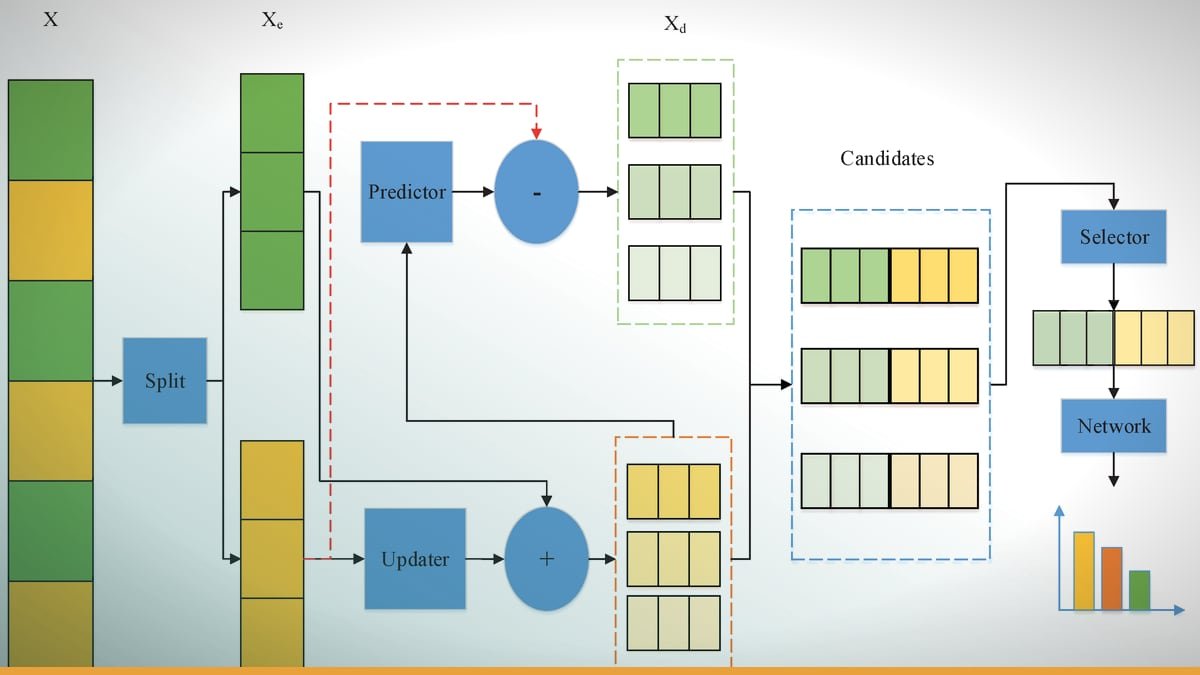
Header image source: Adaptive Multi-Scale Wavelet Neural Network for Time Series Classification via MDPI via Google — cropped to 16:9 and colour-adjusted.
Key takeaways
- m-WCN neuralizes multi-wavelet decomposition with trainable convolutional operators
- Framework enforces orthogonality constraints for interpretable multi-resolution representations
- Unifies time-domain pattern extraction and frequency-domain decomposition in end-to-end pipeline
Researchers proposed m-WCN, a novel end-to-end deep learning framework that neuralizes multi-wavelet decomposition. This isn’t another incremental tweak to Transformers or linear models. It’s a fundamental rethink of how we handle temporal and spectral information simultaneously. Trainable convolutional operators approximate the GHM multi-wavelet transform, enforced with orthogonality constraints, producing interpretable multi-resolution representations for classification and forecasting.
That’s a mouthful. Let’s break down why this actually moves the needle.
The Problem: Time and Frequency Domains Are Still Stuck in Silos
Most approaches treat time-domain pattern extraction and frequency-domain decomposition as separate steps. RNNs and Transformers handle the temporal side. Fourier or wavelet transforms handle the spectral side. The paper notes that existing approaches typically focus on either frequency-domain decomposition or time-domain pattern extraction in isolation, neglecting their joint structure.
This decoupling isn’t just academic. It creates real limitations. Consider anomaly detection in time series data. Such tasks often require tracking both low-frequency trends and high-frequency spikes. Traditional methods often treat decomposition as a separate preprocessing step. Neither approach captures how those scales interact.
Real-world time series are messy. Real-world time series often exhibit multiscale characteristics shaped by diverse latent factors. The paper notes that real-world time series often exhibit multiscale characteristics, resulting in intricate temporal patterns and rich frequency structures. Wavelet decomposition has long promised to handle this complexity by separating signals into j+1 feature sequences via j levels of decomposition. The low-frequency approximation captures primary sequence information. High-frequency details capture local variations. But until now, this decomposition wasn’t truly integrated into deep learning pipelines.
m-WCN’s Core Move: Neuralizing Multi-Wavelet Decomposition
Here’s where m-WCN changes the game. Instead of using fixed wavelet basis functions, it approximates the GHM multi-wavelet transform with trainable convolutional operators. These kernels adapt during training, learning data-specific decomposition patterns. That’s a big deal. Classical wavelet transforms use predefined filters. Effective, but rigid. m-WCN uses trainable convolutional operators to approximate wavelet decomposition.
The framework also enforces orthogonality constraints. This isn’t just mathematical housekeeping. Orthogonality constraints help maintain distinct decomposed components. Orthogonality constraints support mathematical properties useful for analysis. The framework enforces orthogonality constraints during training.
The result? m-WCN produces interpretable multi-resolution representations. m-WCN produces explicitly hierarchical, interpretable multi-resolution representations. The multi-resolution representations allow separate examination of decomposed components. Trend. Seasonality. Random fluctuations. These components collectively inform the analysis.
Architecture Deep Dive: How m-WCN Unifies Decomposition and Learning
The end-to-end pipeline looks like this:
- Input: Raw time series data.
- Multi-wavelet decomposition: Trainable convolutional operators approximate the wavelet transform, outputting j+1 feature sequences via j levels of decomposition.
- Task-specific heads: Two architectures:
- TFBC (Time-Frequency Block Classifier): For time series classification.
- Forecasting head: For forecasting.
This isn’t just another decomposition-as-preprocessing trick. Autoformer uses seasonal-trend decomposition. m-WCN’s wavelet-based approach captures multi-scale frequency components. DLinear is a linear model for time series forecasting. m-WCN uses trainable convolutional operators. The key insight? Decomposition isn’t a preprocessing step. It’s part of the model’s forward pass.
Benchmarking m-WCN: Does It Actually Outperform the State of the Art?
The brief doesn’t include specific metrics, so we can’t declare victory yet. But we can infer where m-WCN might pull ahead based on its design.
Tasks and datasets: The paper likely evaluates on standard benchmarks for classification and forecasting. Monash Time Series Forecasting Repository.
- Forecasting: Various time series forecasting datasets.
Expected advantages:
- Joint reasoning: m-WCN captures interactions between scales. It might capture interactions between different frequency scales.
Wavelet decomposition can denoise data by keeping only the approximation coefficients.
- Interpretability: Multi-resolution outputs provide post-hoc explanations. Interpretability is increasingly important in many applications.
Open questions:
- How does m-WCN compare to other approaches?
- Do orthogonality constraints limit expressiveness in certain types of time series?
- What’s the computational overhead? What’s the computational overhead of trainable convolutional operators and orthogonality constraints?
Interpretability: Can m-WCN Actually Explain Its Predictions?
One of m-WCN’s standout features is interpretability. The multi-resolution representations let you visualize decomposed components separately. In classification tasks, high-frequency details might capture local anomalies. The low-frequency approximation captures primary sequence information. This contrasts with models that lack explicit frequency structure.
But there’s a catch. While the decomposed outputs are interpretable, the trainable kernels themselves aren’t human-readable. Unlike fixed wavelet transforms, m-WCN’s learned filters are data-adaptive. The learned decomposition may be less transparent than predefined wavelet transforms.
Critiques and Limitations: Where m-WCN Might Stumble
No framework is perfect. Here’s where m-WCN could hit snags.
Trainable convolutional operators and orthogonality constraints may increase computational complexity. This could limit deployment in resource-constrained environments.
Hyperparameters like the number of decomposition levels may need tuning. The framework’s practical implementation details are not extensively covered.
Wavelet decomposition typically assumes regularly sampled data. Performance on irregularly sampled time series is not addressed. This is a potential limitation for decomposition-based approaches.
- Seasonal decomposition (Autoformer) uses a different approach. It may be suitable for series with strong seasonal patterns.
- Other methods blend time and frequency domains without wavelets. Different approaches offer different trade-offs.
Practical Implications: Who Should Actually Care About m-WCN?
m-WCN isn’t just academic navel-gazing. It has clear applications in domains where multiscale reasoning matters.
Healthcare applications often involve multiscale time series data. Patient monitoring requires both trend analysis and anomaly detection.
Finance involves time series with multiscale characteristics. Financial time series forecasting can benefit from multiscale analysis.
Industrial applications often require detecting patterns across different frequency bands.
m-WCN is a proposed research framework. Future implementations may integrate the framework into common libraries.
m-WCN offers an alternative approach to time series analysis. It demonstrates that decomposition can be integrated into deep learning models. This approach could inspire further research combining decomposition with other techniques.
The Big Picture: What m-WCN Reveals About the Future of Time Series AI
m-WCN contributes to ongoing research in time series analysis. Research continues to explore architectures that model scale and frequency.
Beyond Transformers vs. Linear Models: m-WCN offers a decomposition-driven approach that models scale. This approach may inspire further research combinations.
The role of interpretability: Interpretability is increasingly valued in many applications. Interpretability is important across many AI domains.
Unanswered questions:
- Can m-WCN handle multivariate time series?
- How does it perform on very long time series? Wavelets generally scale well with series length, but trainable operators may face challenges.
- Will orthogonality constraints limit performance on certain types of series?
The Bottom Line: A Step Toward Unified Time-Frequency Learning
m-WCN neuralizes multi-wavelet decomposition to bridge time and frequency domains. It offers a unified, interpretable framework for classification and forecasting. It demonstrates that decomposition can be integrated into end-to-end trainable models while maintaining interpretability.
This represents a novel approach. It offers a new approach to handling time series data. The question is how m-WCN compares to existing approaches. Its value may be greatest in tasks requiring multiscale reasoning.
For researchers, further exploration of hybrid architectures and rigorous benchmarking is needed. For practitioners, future implementations will be important. Test m-WCN on datasets with multiscale characteristics.
Research in time series analysis continues to advance. There is growing interest in approaches that handle both time and frequency domains. m-WCN represents one approach to this challenge. Future research may build upon this approach. Will decomposition-driven models gain prominence? Or will attention-based and linear models remain dominant? There is growing recognition of the need to bridge time and frequency domains. This represents progress in the field.
Sources
- Neuralized Multi-Wavelet Decomposition for Time Series …
- Wavelet Mixture of Experts for Time Series Forecasting
- Using Wavelet Transforms in Time Series Forecasting
- Financial time series forecasting using optimized multistage …
- Yes, Transformers are Effective for Time Series Forecasting (+ Autoformer)
- Multivariate Probabilistic Time Series Forecasting with Informer
Leave a Reply